The short answer
You can resurface a cracked asphalt tennis court with modular tiles if the base is firm, fairly flat and drains. Fill wide cracks and level any heaves first, then lay the tiles over the top. A regulation 60 x 120 ft court is a weekend job for four or more people.
Tile over the top versus repaving
Repaving means removing or overlaying the asphalt, then coating and lining it again. It takes heavy equipment and a contractor. If the ground under the court is still moving, new cracks can follow the old ones.
Modular tile works differently. It floats on the existing surface and bridges small cracks, so the old asphalt stays out of sight under fresh colour and lines. You do the work yourself. Sections can be unlocked and lifted later if the base ever needs attention.
What condition the base must be in
Tile covers a tired surface. It does not fix a failed base. Walk the court after rain and check each of these.
If large areas have heaved or sunk, the base needs repair before any surface goes on. Photos of the court help when you ask for a quote.
- Firm underfoot, with no soft or crumbling areas
- Fairly flat, with no heaves or sunken sections
- Water runs off and does not sit in large puddles
- Cracks are stable, with both sides at the same height
- Net post footings are solid if you plan to reuse them
Prep: cracks, heaves and cleaning
Fill wide cracks so the tiles are supported across them. Grind or level raised edges and heaves. Fill dips that hold water. Pull weeds out of the cracks, then sweep or blow the whole court clean. Cut back overhanging branches and clear the fence line while you are at it, so leaf litter does not blow straight back onto the court.
The old surface does not have to look good. It has to be flat, hard and clean.
Adding pickleball lines
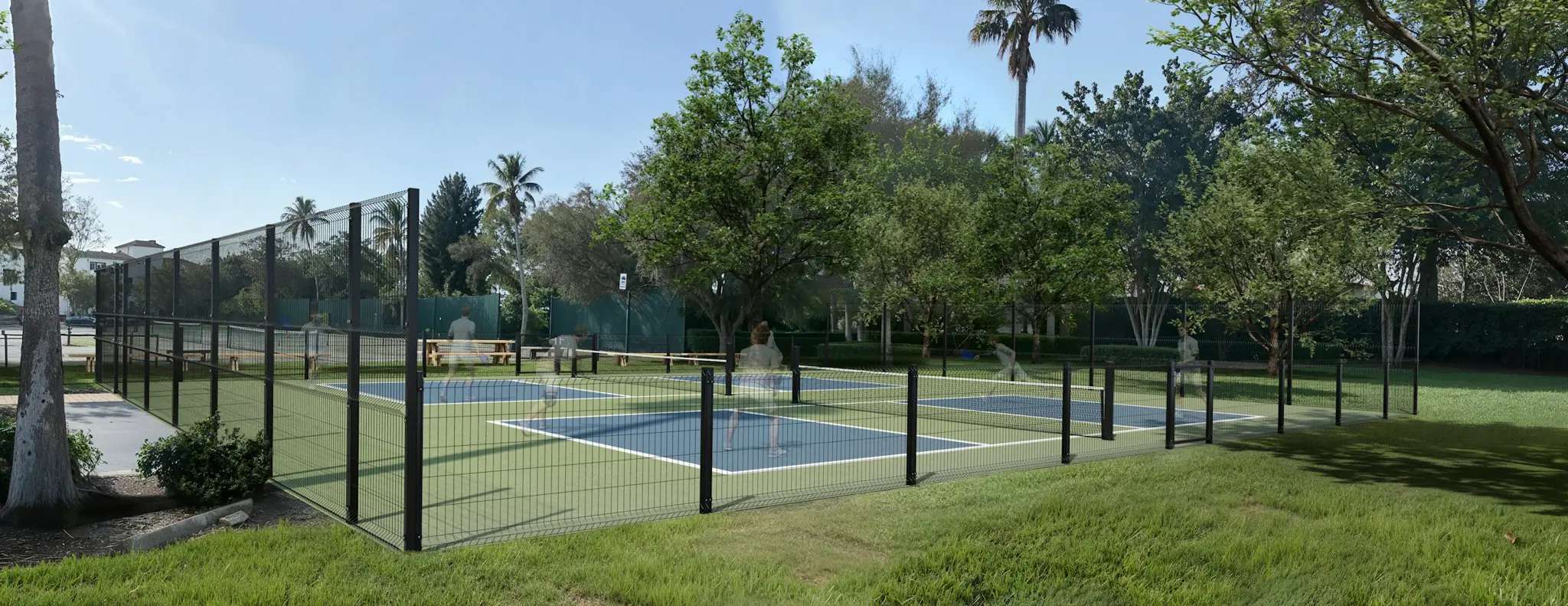
A 60 x 120 ft tennis pad divides into four quarters of 30 x 60 ft. That is the recommended total playing area for one pickleball court, so up to four pickleball courts fit.
Tennis lines go down in one colour and pickleball lines in a second. The tennis court stays regulation: 78 ft long, 36 ft wide for doubles and 27 ft wide for singles.
Kit sizes and prices
Two tennis kits carry the same doubles court. The difference is the run-off around it. Both figures are kit prices before freight and tax.
If your existing court is an odd size, the layout can be adjusted in steps of about a foot.
| Kit | Footprint | Court lines | Kit price |
|---|---|---|---|
| Regulation | 120 x 60 ft | 78 x 36 ft doubles | $44,050 |
| Recreational | 110 x 50 ft | 78 x 36 ft doubles | $33,955 |
Crew size and timeline
A regulation tennis kit covers 7,200 sq ft. Plan on a weekend with four or more people. Finish the base prep beforehand so the weekend is all tile.
Split the crew. Two people carry and place sections while two lock them down with rubber mallets and check the plan. Start from a chalk line snapped square to one edge, leave the expansion gap at the perimeter and fit the edge pieces last.
Reviewed November 2026. Kit prices are in Canadian dollars before freight and tax and are confirmed on your quote.